Land Record Indexing Services for County Recorders

Indexing Is What Makes Your Land Records Usable

Whether your records live in a vault, on microfilm, or in a modern recording system, indexing is what makes them accessible. 

An accurate index transforms a deed from a document on a shelf into a record that can be found in seconds. It connects title researchers, attorneys, staff, and the public to the information they need without digging through books or relying on institutional knowledge. 

RDS indexes land records for Recorders and Registers of Deeds across the country. We build every engagement around how your county records, not with  generic indexing rules applied to all offices.

  • Backfile indexing for historical land records

  • Daily indexing for newly recorded instruments

  • Full-field indexing built to your LRMS requirements



Gray header.png

What Is Land Record Indexing?

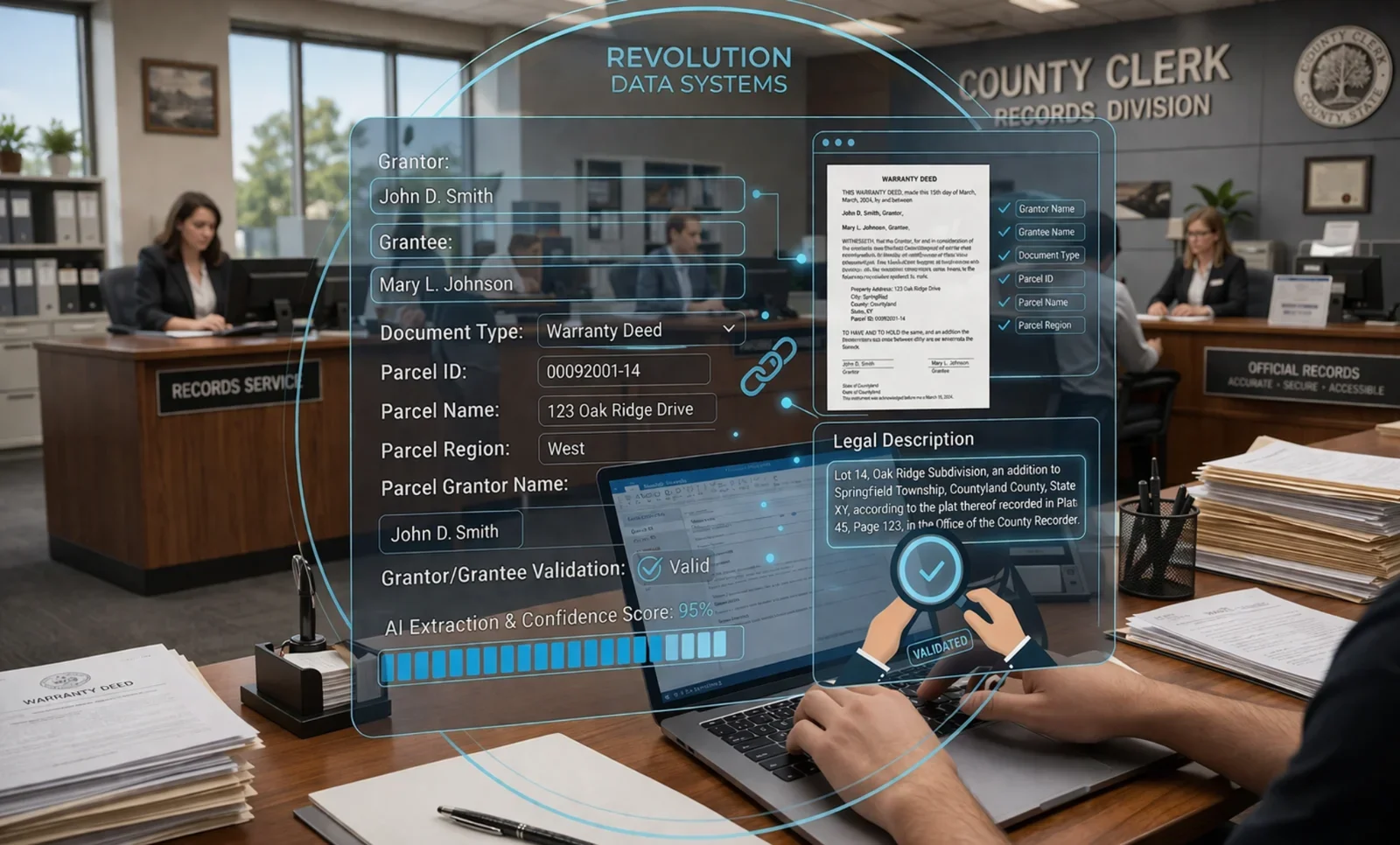
Land record indexing is the process of reading recorded instruments and capturing the key information needed to make those records searchable within your recording system. This typically includes grantor and grantee names, instrument type, recording date, legal descriptions, book and page references, parcel identifiers, and other county-specific fields.

Without indexing, a deed is simply an image. With proper indexing, staff, title companies, attorneys, and the public can locate the right document in seconds using a name, date, parcel number, or other search criteria.

Accurate land record indexing requires far more than data entry. Indexers must interpret handwritten documents, historical records, legal descriptions, recording practices, and county-specific business rules. A 1940 photostat or handwritten deed often requires experience and judgment to correctly identify parties, determine instrument type, and capture information consistently.

While technology can assist with portions of the process, accurate land record indexing still relies on trained professionals who understand the records they are working with. The quality of the index ultimately determines the quality of the search experience for everyone who relies on the public record.


Types of Land Record Indexing for Counties

Most Recorder's offices are managing two distinct challenges at once: a historical backfile that was never fully indexed, and a daily recording workflow where accuracy has to happen under deadline pressure. Both require a different approach.

Backfile Indexing (Historical Land Records)

Backfile indexing is the process of indexing land records—deeds, mortgages, plats, releases, liens, and other instruments—recorded before a consistent, searchable index was in place.

Many counties have decades of records that exist only in bound volumes or early scan files with no associated metadata. Title researchers know these gaps. So does your staff, every time a lookup fails or a constituent waits at the counter while someone pulls a book.

What it involves: A scoped project to index your historical archive using county-specific field requirements, delivered in a format ready for import into your recording system. Projects are typically phased by date range or instrument type based on where gaps create the most operational friction.

When it makes sense: When your office is modernizing, preparing for a system migration, addressing title research complaints, or closing known gaps in a specific time period. Most counties start with the most-searched years—often the last 20 to 40 years—and work backward.

What to consider: Backfile indexing involves real trade-offs between scope, budget, and timeline. Whether you start with book-and-page indexing or move directly to full-field indexing depends on what your title researchers and staff actually need, and how quickly public search accuracy has to improve.


Daily Indexing (Day-Forward Recording)

Daily indexing covers every instrument recorded with your office today, this week, and going forward. Deeds, mortgages, releases, liens, plats, assignments—every instrument your office accepts needs to be indexed accurately before it's available for public search. On a deadline. Every recording day.

That's not a project. It's an operational function that runs alongside everything else your office manages.

What clerks are managing today: Incoming volume doesn't wait for ideal conditions. Staffing constraints, same-day turnaround expectations, and the complexity of interpreting instruments under time pressure all create indexing risk. When volume spikes—refinancing waves, tax season, estate activity—something usually gives.

Your options:

In-house:

Your staff handles all indexing as instruments are recorded. Works well when volume is steady and capacity is sufficient to maintain accuracy without shortcuts.


Vendor-supported:

An external team handles daily indexing production, freeing your staff for recording, customer service, and counter work.


Hybrid:

In-house staff handles standard intake; a vendor supports high-volume periods, complex instruments, or overflow.

Daily indexing accuracy compounds over time. Errors made today become the chain-of-title problems that title companies call about in five years.


Our Approach to Land Record Indexing

We know land records—not just documents. Our indexing teams understand instrument types, grantor/grantee naming conventions, and the judgment calls that come up when a 1930s deed doesn't follow a standard format or a legal description is ambiguous. That context doesn't come from a training module—it comes from working with county land records directly.

We index the way Recorders read. Recognizing what an instrument is by its content, catching recording errors before they become index errors, understanding how legal descriptions and parcel references are supposed to work—that's interpretation, not data entry. We're not filling fields from a screen.

We build around your recording system. An accurate index that doesn't import correctly into your LRMS is just a spreadsheet. Every indexing engagement is built around your platform—Fidlar, iCounty, Harris Aumentum, Harris Eagle Recorder, Tyler Eagle Recorder, Tyler Odyssey, Cott Systems, Neumo, GovOS legacy systems, Granicus, S&S, Delta, Landed, IQS, LGS, NetData, Alliance, Thomson Reuters, i3 Verticals, NewVision, and other county recording platforms—so data arrives ready for import without reformatting or cleanup falling on your staff.

We don't rely on AI. Automated indexing struggles with handwritten instruments, bound volumes, multi-document pages, and the irregularities that are common across decades of land records. The result is an index that looks complete on the surface but contains field errors that surface during title research. We use technology where it helps; human review handles the judgment calls.


Common Indexing Problems in Recorder's Offices


Scanned but not searchable.

Documents exist in the system but can't be retrieved by grantor name, instrument type, or recording date. The scan happened—the index didn't. Staff are still pulling paper books or searching microfilm to answer questions that the digital system should handle.

Inconsistent historical indexing.

Name formats, instrument classifications, and field conventions vary across decades of records. A searcher looking for a deed recorded under "John T. Smith" in 1965 won't find it if it was indexed as "J.T. Smith." Chain-of-title gaps follow.

Backlog pressure with no clear path forward.

Recording volume keeps coming in while the historical archive waits. Staff don't have capacity to catch up, and a large-scale backfile project feels too complex to scope. The gap grows.


Vendor mismatch with your recording system.

Indexed data was delivered in a format that doesn't align with your LRMS. Import errors, broken field mappings, and manual cleanup follow—all of it falling on county staff after the vendor has moved on.

AI indexing errors in legacy records.

Handwritten instruments, photostat copies, and bound volumes are exactly where automated indexing fails. Incorrect field entries and missed grantors don't always get caught until a title researcher calls with a problem.


How We Work With Your Office

  1. Review your current index—formats, fields, volume, and gaps specific to your land record archive

  2. Identify inconsistencies across your backfile and day-forward instruments

  3. Recommend an approach—backfile, daily, hybrid, or phased—based on where gaps create the most operational and title-research risk

  4. Execute with QA and LRMS alignment, so indexed data lands in your recording system clean and ready to use

We don't hand off a spreadsheet and leave your staff to figure out the import. Delivery means your system is updated and working.

Not Sure Where Your Index Stands?

We'll review a sample of your land records and flag gaps, inconsistent field conventions, or chain-of-title risks in your current index.


No obligation—just a clear read on where your indexing quality actually stands.


Frequently Asked Questions About Land Record Indexing


Contact Us