Accessibility on Demand (AoD) for Government ADA Compliance

Make public-facing PDFs accessible, compliant, and searchable at scale. Revolution Data Systems (RDS) delivers accessibility on demand solutions that automate PDF remediation for government agencies— Send us a few PDFs and we'll remediate them free so you can see the output and get a scoped plan.

 
Gray header.png
 

 Why Government Agencies Are Struggling with ADA Compliance

The Department of Justice's 2024 final rule under ADA Title II sets enforceable digital accessibility standards for state and local governments. Compliance deadlines were subsequently adjusted by a 2026 Interim Final Rule—these are the current deadlines under the IFR—and DOJ has indicated that further rulemaking is possible.

Compliance timeline

  • April 26, 2027—agencies serving populations of 50,000 or more

  • April 26, 2028—smaller public entities and special district governments

Documents used to access government services, programs, or activities must meet WCAG 2.1 Level AA standards—and that includes PDFs.

The problem: most agencies have backlogs in the thousands. Some have tens of thousands of documents that aren't accessible—missing structural tags, no reading-order logic, and no alt text for images. Manual remediation runs $8 to $25 per page, based on published industry estimates. A 10,000-page archive at those rates can top $250,000.

The agencies making progress on this are the ones that have sized their backlog, run the cost math, and moved away from manual workflows.


What Is Accessibility on Demand (AoD)?

Accessibility on Demand (AoD) is an automated document remediation solution that converts inaccessible PDFs into ADA-compliant, accessible formats. Rather than sending documents to a human specialist who spends 15 to 30 minutes per page making manual fixes, AoD uses OCR and accessibility tagging to process documents quickly—and at a fraction of the cost.

The output is a tagged, structured PDF designed to work with screen readers and assistive technologies, meet WCAG 2.1 Level AA requirements, and support compliance audit review. RDS delivers PDF accessibility remediation services built specifically for the volume and format complexity common in government document environments.

For government agencies managing large archives of public records, AoD is how you get from thousands of inaccessible documents to a compliant, accessible library—without waiting years or paying for it all out of a single budget cycle.

RDS uses automation where automation belongs. Accessibility tagging is rules-based and repeatable, making it a good fit for a technology-driven process. Indexing a deed or a land record, by contrast, involves judgment calls that a title company or court may rely on for decades—calls that remain human-verified on RDS's side of the house. AoD and RDS's indexing teams solve different problems with the right tools for each. 


How Accessibility on Demand Works

Documents are processed against WCAG 2.1 Level AA and PDF/UA accessibility standards to support screen reader compatibility and audit readiness. Three steps. No overhaul of your existing systems required.

Upload or Identify Your PDFs

RDS reviews your document inventory—active PDFs, legacy archives, public-facing forms, and scanned records. We assess complexity and volume to build a remediation plan.

Automated OCR and Accessibility Remediation

AoD applies OCR processing, structural tagging, reading-order sequencing, image alt text, form field labeling, and document metadata. Each document is processed against WCAG 2.1 Level AA and PDF/UA standards.

Receive Accessible, Audit-Ready Documents

Remediated documents are delivered as accessible PDFs designed to support ADA compliance with PAC compliance reports—ready for your website, public portal, or records management system. Because AoD is a remediation step, not a storage system, most agencies route finished files straight into their existing records management system or into Cyclone, RDS's secure digital vault, so nothing sits waiting to be filed somewhere else.


Manual PDF Remediation vs. Accessibility on Demand

Comparison Manual Remediation Accessibility on Demand
Cost per page $8–$25 $0.30–$2
Speed 15–30 min/page Seconds to minutes
Scalability Difficult at volume High-volume batch processing
Consistency Varies by specialist Standardized output
Audit-ready reporting Manual documentation Built-in compliance reports
Government readiness Requires dedicated staff Built for public sector scale

Cost-per-page figures reflect published industry estimates from 2024–2025. Accessibility on Demand pricing varies by document complexity and volume.

For an agency with 20,000 documents, the difference between manual and automated remediation can exceed $400,000—before accounting for staff time.


Benefits of Accessibility on Demand

Reduce Compliance Risk

Support ADA Title II, Section 508, WCAG 2.1 AA, and PDF/UA alignment with accessible PDFs designed for public-sector compliance needs.

Serve More Constituents

Accessible documents let residents who use screen readers or other assistive technology reach public records on their own. That's both a legal requirement and a basic service standard.

Lower Remediation Costs

Automated processing brings per-page costs down to fractions of what manual remediation runs. The budget goes further. Backlogs shrink faster.

Improve Public Transparency

Accessible records are searchable, navigable, and usable. That's better for staff, better for requestors, and better for public trust.

Support ADA and WCAG Initiatives Agency-Wide

AoD integrates into existing document management workflows without forcing your office to change platforms or systems.


Who Needs Accessibility on Demand?

County recorders and clerks 

Managing high volumes of land records, deed instruments, and public filings? Every document used to access government services must be accessible. AoD remediates backfile archives and keeps new filings compliant. Not sure where to start? Our guide on records digitization priorities walks recorders through a strategic sequencing approach.

County IT and technology teams 

IT departments are typically the ones evaluating, budgeting for, and approving PDF remediation across the county—especially once a backlog is shown to extend well beyond the recorder's office into every department's PDFs. If you're the one sizing an accessibility backlog or building a business case for the board, AoD integrates with your existing document workflows without requiring new platforms and scales cleanly from a five-document assessment to your full inventory.

Municipal governments 

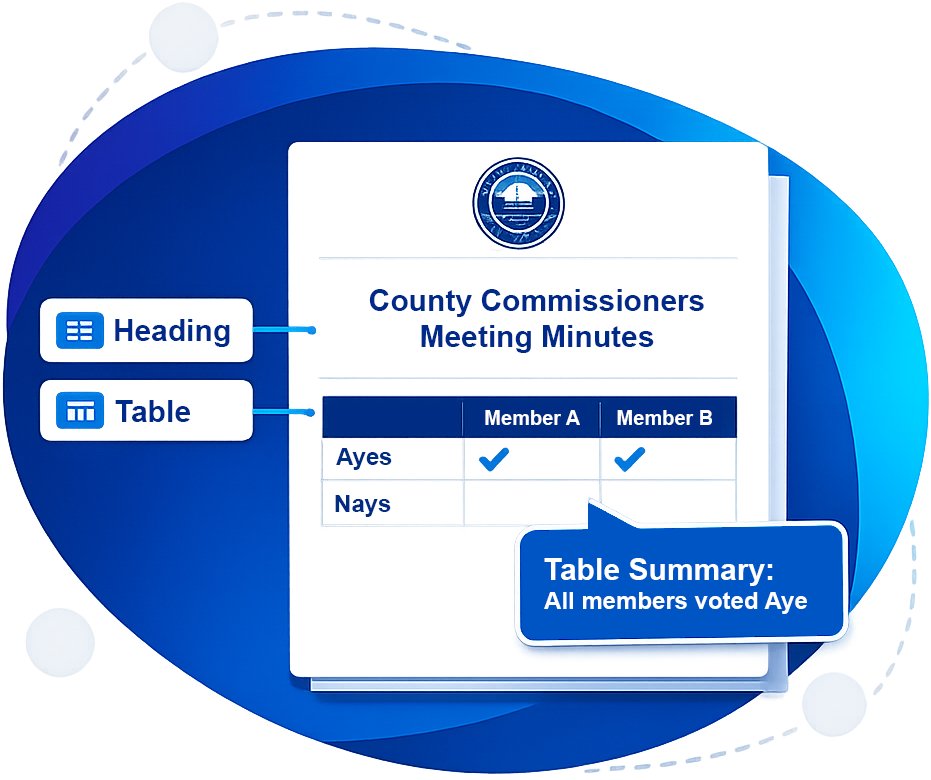
City and town offices publishing ordinances, meeting minutes, permit forms, and public notices online need accessible PDFs—not just accessible web pages.

Courts 

Court documents are subject to ADA Title II requirements. Case filings, schedules, and public dockets must be accessible to all users.

State agencies 

Large state departments with enterprise-level document volumes need batch remediation at scale—not specialist-by-specialist manual review.

Public archives 

Historical records and legacy document collections flagged for public access need accessibility treatment, especially those used for ongoing research or reference. See how agencies approach preserving inherited records before digitizing.

Public schools and districts 

Educational institutions managing student-facing and public-facing documents face compliance requirements under both ADA Title II and state-level mandates.
 

What ADA Title II Compliance Actually Requires

Under ADA Title II, state and local governments are required to make public-facing digital content—including PDFs—accessible to WCAG 2.1 Level AA standards. That obligation applies whether a document is produced directly by your office or through a contractor, vendor, or other third-party arrangement. It doesn't transfer away, and it doesn't expire by waiting.

The math tends to make the case better than the deadline does. Manual remediation runs $8 to $25 per page, and a backlog of even a few thousand documents adds up quickly, whether or not enforcement ever becomes a factor. Agencies that start clearing their backlog early spend less overall and never have to treat compliance as an emergency.

A few things worth knowing as you plan

  • Some of your backlogged PDFs may not have originated with your office. If a document came from a state agency, a federal department, or another government body, that source is generally responsible for making it accessible before it reaches you. Identifying which documents in your inventory came from elsewhere can meaningfully shrink what's actually yours to fix.

  • For historical and back-file records, remediating on demand is a low-cost hedge—so your agency can fulfill any accessibility request quickly when it comes in.

  • Agencies should not rely on accommodation requests as their only accessibility process for public-facing documents.


Why Government Agencies Partner with Revolution Data Systems

RDS serves roughly 1,000 of the 3,100 U.S. counties and has about 100 million scanned county records already in its workflow. That's not a recent pivot. It's the scope of what we do.

PDF remediation for government agencies is delivered by the same team in the same workflow as document scanning, records indexing, and long-term digital preservation—serving county, municipal, and state agencies across the country. Accessibility on Demand is a natural extension of that expertise, not a standalone offering from a vendor starting from scratch.

What that track record means for your agency

  • No need to manage a separate vendor relationship for accessibility

  • Remediation happens in the same workflow as document scanning and indexing

  • RDS understands retention rules, disclosure requirements, and how government records are actually used

  • We work with rural offices managing modest backlogs and high-volume agencies managing hundreds of thousands of documents

If your agency is already working with us on records management, accessibility remediation is a natural next step. If you're coming to us specifically for ADA compliance, we can assess your document inventory and build a remediation plan that fits your timeline and budget.


 Frequently Asked Questions

Start Your ADA Compliance Strategy

If your agency is managing a backlog of inaccessible PDFs, the most practical step is knowing what you're working with. RDS assesses your document inventory, estimates remediation volume, and builds a plan that fits your timeline and budget.

Whether your priority is clearing a legacy archive, staying ahead of new filings, or meeting a specific government accessibility compliance deadline, AoD gives you a scalable path that doesn't require new software, new staff, or a multi-year budget commitment.